OCTOBER 14, 2026
Structured Cabling Installation Cost in Akron, OH | UnlimitComp
Structured cabling installation in Akron, OH, typically starts with a per-connection estimate rather than one fixed project price. For preliminary budgeting, commercial Cat6 installations commonly fall between $125 and $400 per cable drop, based on published 2026 U.S. market estimates. A small office might need a few thousand dollars in cabling, while a larger building with extensive network requirements could cost considerably more. Your actual price depends on cable type, building access, installation labor, and how many connections your business needs.
At UnlimitComp, we work with Akron businesses on structured cabling, network design, and IT infrastructure. Understanding what affects installation costs makes it easier to establish a realistic budget and compare contractor proposals before work begins.
Average Structured Cabling Installation Cost in Akron, OH
Commercial network cabling contractors often calculate installation costs using the number of cable drops.
A cable drop generally refers to one cable running from a central network location to a connection point, such as a workstation, wireless access point, or security camera. An office with 15 desks doesn’t necessarily need only 15 drops. Some workstations require multiple connections, and other equipment may need dedicated wiring.
For early budgeting, businesses can use these broad commercial Cat6 installation estimates:
- 10 cable drops: $1,250 to $4,000
- 20 cable drops: $2,500 to $8,000
- 40 cable drops: $5,000 to $16,000
- 60 cable drops: $7,500 to $24,000
These examples use a $125 to $400 per-drop planning range. They’re illustrative calculations, not confirmed Akron market averages or UnlimitComp quotes. The final project cost may fall outside these estimates.
The figures also assume conventional cable runs. Additional equipment, new conduit, telecommunications room construction, extensive wall repairs, or unusual installation conditions may increase the total.
For many Akron offices, the most useful starting point is determining how many connections the business needs and what the building already has in place.
What Affects the Cost of Structured Cabling Installation?
Two businesses with the same number of employees can receive very different installation estimates.
One may occupy a modern office with accessible ceiling panels and existing cable pathways. The other might operate from an older commercial building with finished ceilings, difficult wall access, and outdated infrastructure.
Those conditions affect how much time installers spend completing each connection.
Building Layout and Accessibility
Accessibility often has a greater impact on installation labor than the cost of the cable itself.
Suspended ceilings usually make it easier to route cables between rooms. Finished drywall ceilings may require additional access openings or more complicated cable routing.
Older Akron commercial properties can present challenges such as masonry walls, limited cable pathways, and multiple floors.
Before budgeting, consider where installers will need to run cables and whether they can access those locations without substantial building modifications.
Number and Length of Cable Runs
The total number of connections affects both material quantities and labor.
Larger projects may benefit from more efficient installation scheduling because technicians can complete multiple cable runs while working in the same area.
However, a building with long corridors, distant equipment rooms, or separate work areas may require substantially more cable than a compact office.
Run length matters for performance, too. Standard copper Ethernet installations have channel-length limitations, so contractors need to select appropriate pathways and technology rather than extending cable indefinitely.
Cable Type and Performance Requirements
Different Ethernet cable categories support different performance needs.
Cat6 is a common choice for business networks, workstations, wireless access points, and connected security equipment.
Cat6A supports 10 Gigabit Ethernet over the full standard 100-meter channel distance when the installation and components meet applicable specifications. It typically costs more because of its cable construction, termination requirements, and installation considerations.
Fiber optic cabling serves different purposes, particularly when businesses need high-bandwidth connections between network rooms or across longer distances.
The right selection depends on how the network will operate. A small professional office may have different requirements from a manufacturing facility or a business connecting multiple floors.
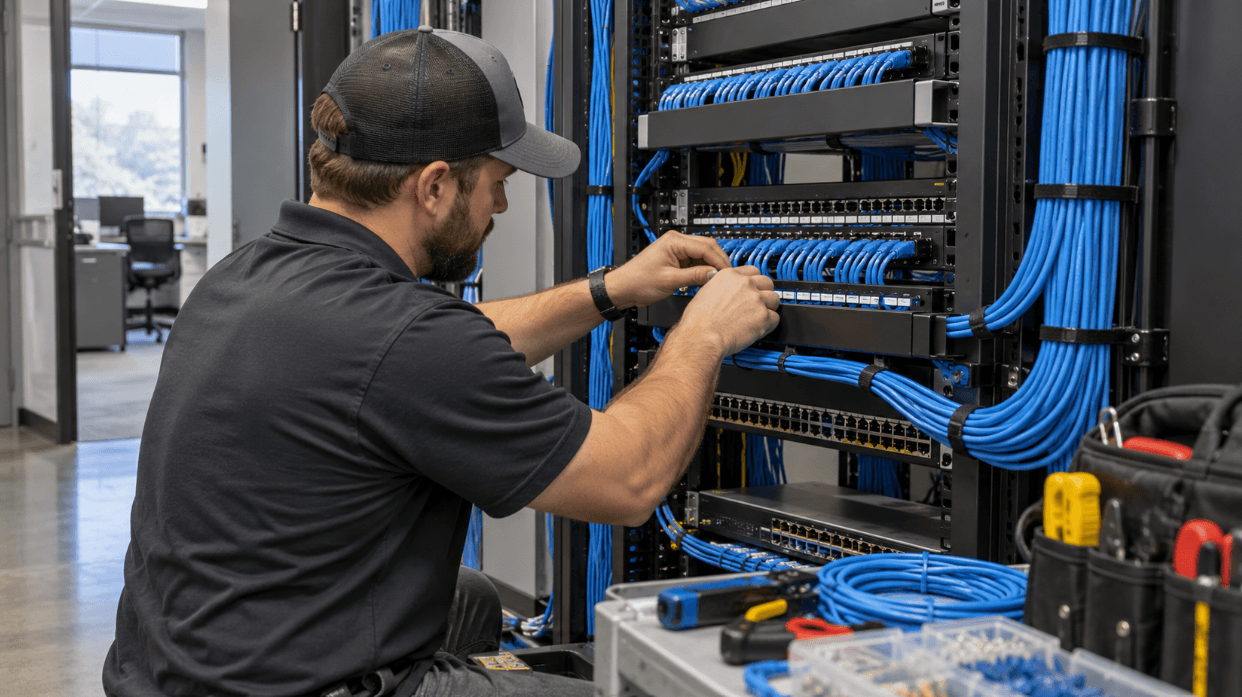
Our structured cabling services include Cat6, Cat6A, and fiber optic installations, along with cable management and testing.
How Much Does Cat6 Cabling Cost Compared With Cat6A?
Cat6 usually has a lower initial installation cost than Cat6A.
For many conventional office networks, Cat6 provides sufficient performance without the additional installation expense associated with higher-category cable.
Cat6A becomes worth considering when the network requires 10 Gigabit performance across longer copper runs or when equipment requirements justify the additional bandwidth capability.
Consider an Akron accounting office installing 20 wired workstation connections. If its current network runs primarily at 1 Gigabit, Cat6 may meet its foreseeable needs.
A business preparing a new network for demanding applications or specific high-speed equipment could have stronger reasons to evaluate Cat6A.
Replacing functioning cabling solely because a newer category exists isn’t always necessary. The existing cable’s condition, performance, and compatibility should guide that decision.
Businesses should also distinguish cable performance from internet speed. Installing Cat6A won’t automatically increase the speed of an internet plan, router, or network switch.
Does an Existing Building Cost More to Cable Than New Construction?
Existing buildings often require more installation labor, particularly when walls and ceilings are already finished.
During new construction or a major renovation, contractors can coordinate cable pathways before drywall installation. They may install support systems and route cabling while the space remains accessible.
Retrofitting an occupied business requires more planning.
For example, an Akron medical office might need additional network connections without interrupting patient appointments. A retailer may need technicians to work around merchandise displays and customer traffic.
Some projects also require evening or weekend access, which can change labor pricing.
Building age alone doesn’t determine the cost. A well-maintained older property with accessible ceiling space may be easier to cable than a newer building with limited pathways.
Ask prospective installers to examine the actual route between the network equipment and each proposed connection location.

What Should Be Included in a Structured Cabling Installation Quote?
A low per-drop price doesn’t necessarily mean the complete project will cost less.
One contractor may quote only the cable installation. Another may include termination, labeling, performance testing, and documentation.
Before comparing proposals, confirm whether the price includes:
- Cable materials appropriate for the building and application
- Cable routing and installation labor
- Network jacks, connectors, and face-plates
- Patch panel connections and terminations
- Cable organization and labeling
- Testing and certification documentation
- Any required conduit or supporting pathways
- Cleanup and removal of installation debris
- Necessary permits or additional construction work, where applicable
Ask which items the contractor excludes.
For example, network switches, wireless access points, and equipment racks aren’t automatically part of every structured cabling estimate.
Cable testing deserves particular attention.
An Ethernet connection might appear to work while still having wiring defects or performance problems. Proper testing checks whether the completed installation meets the intended performance requirements.
The telecommunications industry association BICSI explains the importance of correct cable installation, termination, testing, and documentation.
At UnlimitComp, our structured cabling work includes testing and certification, along with cable labeling and documentation. Those details make the infrastructure easier to maintain as business requirements change.
Can Businesses Reuse Existing Network Cabling?
Reusing functional cabling can reduce the amount of new installation work, but the existing system needs evaluation first.
A business moving into an Akron office may discover that previous tenants left behind Ethernet outlets, patch panels, and cable runs.
Those components could still be useful.
However, the presence of a network jack doesn’t establish that the connection works properly or supports the required performance.
Before assuming the existing infrastructure is suitable, determine:
- Which cable category is currently installed?
- Are the outlets connected to working patch panels?
- Do the cable runs pass appropriate performance tests?
- Are cable labels accurate?
- Can the current pathways accommodate additional connections?
An inspection may reveal that some cabling can remain while other sections require replacement.
Partial upgrades can make sense when most of the network works properly and only particular areas need improved connectivity.
Our network design services address existing infrastructure, network topology, performance requirements, and future expansion.
How Can Akron Businesses Keep Network Cabling Costs Under Control?
The easiest way to avoid unnecessary cabling expenses is to plan the installation around actual equipment requirements.
Start by identifying every location that needs a wired connection.
Count workstations, printers, wireless access points, security cameras, conference room equipment, and other network-connected devices.
Then consider upcoming changes.
If your business expects to add employees or expand into an adjacent office, discuss those plans before the installation begins. Running a few carefully selected additional connections during the original project may cost less than scheduling another installation later.
Avoid ordering cable drops for locations without a reasonable expected use. Extra capacity should have a purpose.
Businesses renovating their properties should also coordinate cabling with construction schedules. Installing the wiring while walls and ceilings are accessible can reduce the labor needed for future modifications.
For occupied buildings, agree on installation hours and equipment access before work begins.
Finally, request a written scope that identifies the expected connections, cable specifications, testing requirements, and exclusions.
That document gives your business a clearer basis for evaluating the final cost.
How Long Does Structured Cabling Installation Take?
Installation time depends on the size and condition of the building.
A small office with accessible cable pathways may require only a few working days. Larger installations involving multiple floors, complicated routing, or extensive network equipment can take considerably longer.
The number of drops provides a useful starting point, but it doesn’t tell the entire story.
A technician installing 20 connections throughout a large property may spend more time routing cable than someone installing the same number of connections inside a compact office.
Testing, labeling, equipment organization, and documentation also take time.
Businesses should discuss scheduling before approving the project, especially when installation work could interrupt normal operations.
UnlimitComp evaluates installation requirements and project timelines based on the property and the infrastructure involved.
Getting a Structured Cabling Estimate in Akron, OH
A reliable installation estimate starts with a clear description of the building and the connections you need.
Before requesting a quote, gather your approximate square footage, number of workstations, equipment locations, and any available network diagrams.
Photos of existing network closets, patch panels, and ceiling areas may also be useful during the initial conversation.
At UnlimitComp, we provide structured cabling installation, network design, testing, and ongoing support for business technology systems. Our office is located in Akron, and we work with businesses throughout Northeast Ohio.
If you’re planning a new office network or upgrading existing cabling, contact our team or call (330) 360-8562 to discuss your project.
For a realistic budget, begin with the number of cable drops and the condition of your building. Then confirm the installation scope, materials, and testing requirements in writing. Those details will give you a far more useful cost estimate than a general price per foot of Ethernet cable.





Stay Connected
Subscribe for technology tips, service updates, and security insights.